


Quick Answer. A tantrum is goal-directed: your child is upset, still in control, trying to get something. A meltdown is neurological overload — your child has lost control entirely and cannot stop, even if they wanted to. The strategy that works for one makes the other significantly worse. Here's how to tell them apart in 5 seconds, and exactly what to do next.
For two years, I was responding correctly.
To the wrong thing.
I held boundaries. I stayed calm. I waited it out. I followed every piece of advice I'd ever read. And nothing got better. If anything, things got worse. Longer episodes. More exhaustion. More nights lying awake wondering what I was doing wrong.
I wasn't doing anything wrong.
I was just misreading the situation every single time.
There are two completely different things that look identical from the outside — both involve screaming, both involve a child on the floor, both feel like chaos. But inside your child's brain, they are happening in different places, driven by different systems, and they require opposite responses.
One of them responds to calm firmness. The other one gets worse with it.
I had been applying calm firmness to both.
That's the thing nobody tells you. Not because they're hiding it. Because most parenting advice doesn't make this distinction at all.
87% of Toddlers Have Tantrums.
Yours Isn't Broken.
Before anything else — the number that changes the context of everything that follows.
According to a 2021 review published in StatPearls (NIH), 87% of children aged 18–36 months have tantrums — making this one of the most universal experiences in early childhood. Tantrum frequency peaks between ages 2 and 3, then naturally declines toward age 4–5.
What that means in practice:
- 12% of 2-year-olds have daily tantrums — still within normal developmental range.
- 4.4% of children ages 3–5 have daily tantrums — at this age and frequency, worth a conversation with your pediatrician.
- Average episode: 1–5 minutes for ages 1–3; up to 10 minutes for ages 4–5.
- Boys and girls are exactly equal in frequency and intensity. Research finds no gender difference.
And the question parents search at 11 PM: Why is my 3-year-old getting worse, not better?
Often, it's not that the behavior is escalating. It's that the response isn't working — because the wrong tool is being used for the wrong situation. By the end of this article, you'll know which tool to pick. And why it matters more than any specific technique.
Tantrum vs. Meltdown:
Two Different Brains. Two Opposite Responses.
This is the section most parenting articles don't have.
It's also the most important one.
What's Actually Happening in the Brain
When your child loses it, one of two neurological events is taking place — and they are not interchangeable.
A tantrum originates in the more developed parts of the brain: the prefrontal cortex (planning, decision-making) working alongside the limbic system (emotions). Your child is experiencing big feelings, but they are still partially in the driver's seat. They know what they want. They are, on some level, tracking your response. The tantrum is communication. Loud, exhausting, floor-level communication. But communication.
A meltdown is something different entirely.
It's what child psychologists call emotional dysregulation: the brain's alarm system has completely overridden the thinking brain.The rational part of your child's brain has gone offline. They are in full fight-or-flight.
The prefrontal cortex is not available. Not the part that hears your words, responds to your calm, or chooses to stop.Not because your child is being difficult. Because they literally cannot access it right now.
A tantrum: your child is pressing the horn. Loudly. Deliberately.
A meltdown: nobody is driving.
The 5-Second Diagnostic Test
You don't need to analyze brain scans in real time. You need one question:
"If I gave them exactly what they want right now — would they stop?"
- Yes, probably — Tantrum. Goal-directed. There is something your child wants to get or avoid.
- No, or I genuinely don't know what they want — Meltdown. Neurological overload. There is no "want" to address.
This question changes everything that follows.
The Signs Side by Side

How to Handle a Toddler Tantrum:
3 Steps That Stop the Cycle
Now that you know what you're working with — here's what to actually do.
What NOT to Do (and Why It Backfires)
Three responses that seem reasonable and make everything worse:
Giving in. Every time a tantrum achieves its goal, the child's brain logs it as a winning strategy. This is operant conditioning — behavior that is reinforced is repeated. Holding the line isn't cruelty. It's protecting your child from learning a pattern that will follow them into school, friendships, and beyond.
Explaining, reasoning, negotiating. When your child is in tantrum mode, the prefrontal cortex (the part that processes logic and language) is significantly less accessible. Your carefully constructed explanation about why we don't buy sugar cereal is entering a room where the lights are dimmed. Say it once. Then stop.
Meeting heat with heat. Research on emotional contagion shows that an escalating parent almost always escalates the child. Your nervous system is communicating with your child's nervous system in real time. When you go up, they go up. This isn't a parenting failure. It's neurobiology.
The 3-Step Response
Step 1. Name it. Once.
"You're really frustrated right now. You wanted that."
One sentence. No lecture. Naming an emotion briefly activates the prefrontal cortex — it begins to bring the thinking brain back online. It also signals: I see you. I'm not your enemy.
Step 2. Hold the boundary. Say nothing else.
The limit stays. You've stated it. Don't justify, don't repeat, don't negotiate. Stay nearby. Stay calm. Wait.
This is the part that feels wrong. It isn't.
You are teaching your child that big feelings are survivable — and that they don't change outcomes.
Step 3. Reconnect after.
When it's over — five minutes, not five seconds — reconnect physically before any words. A hug. Sitting together. Then, briefly: "That was hard. I love you."
No debrief. No lesson. The repair after the rupture is where the actual learning and connection happen.

What Gentle Parenting Gets Right
— and Where It Gets Complicated
Gentle parenting (popularized by voices like Dr. Becky Kennedy and Sarah Ockwell-Smith) is built on emotional attunement, co-regulation, and connection over punishment.
The foundation is sound. Research consistently shows that responsive, warm parenting builds stronger long-term emotional regulation, lowers baseline stress hormones, and supports healthy prefrontal cortex development. A child who consistently experiences parental warmth develops measurably better-regulated emotional responses over time.
But — and this is the nuance social media frequently skips — not all popular gentle parenting advice reflects the research. A 2024 review in Psychology Today found something counterintuitive: intensive emotional engagement during a tantrum can run counter to what evidence-based treatments recommend. Withdrawing attention calmly (not cold abandonment — quiet, warm non-engagement) is more effective at reducing tantrum frequency than emotional amplification in the moment.
Gentle parenting's core is right. Empathy, connection, no shame, no harsh punishment. The timing adjustment: the deep emotional work belongs before and after the episode — not in the middle of it.
When It's a Meltdown:
The 4-Step SAFE Protocol
to Calm a Screaming Toddler
A meltdown is not a tantrum that escalated. It is a different neurological event. It requires the opposite response.
Why "Hold the Line" Works for Tantrums
— and Backfires in Meltdowns
Maintaining a boundary during a meltdown doesn't teach resilience. It adds stimulation to a nervous system that is already completely overwhelmed.
Your child is not choosing this. They are not calculating. They are not watching to see if you'll give in. The part of their brain that could do any of those things is offline.
Talking during a meltdown doesn't help. It adds input. Commanding doesn't help. It adds threat. Explaining doesn't help. There's no one home to hear it.
This is also why tantrums sometimes appear to get worse when you first start holding firm boundaries. The behavior escalates briefly because the child's brain is testing whether the old strategy still works. This is called an extinction burst in behavioral psychology. It looks like things getting worse. They're not.They're about to improve. But that escalation is tantrum behavior — strategic, goal-directed. A meltdown doesn't escalate strategically. It overwhelms.
Knowing the difference in real time tells you whether to hold or shift.
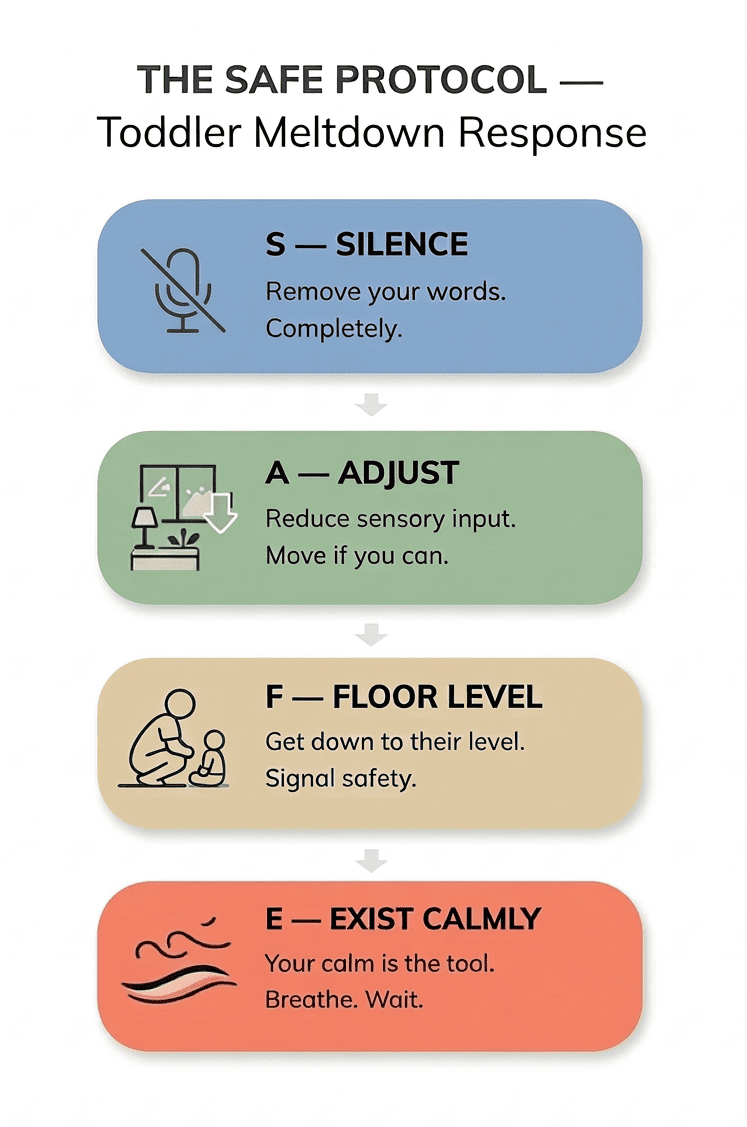
The SAFE Protocol
S — Silence. Remove your words almost entirely. No instructions. No explanations. No "I know you're upset" — even that is input. A calm, quiet presence communicates safety without adding stimulation.
A — Adjust the environment. If you can identify and reduce the trigger — the noise, the crowd, the overstimulation — do it. Not as giving in. As triage. The boundary conversation can happen after the nervous system comes back online.
F — Floor level. Get down to your child's level. Standing over a dysregulated child activates more threat response. Sitting near them, not on top of them, signals safety.
E — Exist calmly. This is the hardest one. Don't perform calm. Be calm. Your nervous system is the anchor. Breathe slowly. Your child's nervous system will gradually begin to synchronize with yours — this is co-regulation working exactly as it's designed to.
Toddler Meltdown in Public:
A 5-Step Survival Guide

This is the scenario that breaks parents. The grocery store. The birthday party. The doctor's waiting room. Eyes on you. Judgment in the air.
First: the people around you are not judging you the way your nervous system is reporting. Most of them are parents who have stood exactly where you are. The ones who aren't — don't matter.
Practical steps, in order:
- Move if you can. A change of environment can interrupt the sensory loop. Outside, a quieter corner, your car — anywhere with fewer inputs.
- Get low. Get quiet. SAFE protocol. You don't need to perform composure for an audience. You need to be an anchor for your child.
- Drop the timeline. The pressure of the schedule is what makes public meltdowns spiral. Your child needs 5 minutes. Give them 5 minutes. The checkout line will still be there.
- Block additional input. Well-meaning bystanders, store employees, older relatives may try to help by talking, offering alternatives, or reasoning. Politely create space. More voices are the opposite of what's needed.
- Reconnect before moving on. Once it passes, and it will, a brief physical connection before resuming normal activities. Not a debrief. Not a lesson. Just a moment of normal.
How to Prevent Toddler Tantrums:
4 Triggers Most Parents Miss
The best tantrum response is the one you never need.
Trigger 1: Transition Moments
Moving from one activity to another is the single most common tantrum trigger in children ages 2–5. For a toddler, every transition is a small loss — leaving something familiar and safe for something unknown. The solution isn't eliminating transitions (impossible). It's making them predictable.
Five-minute warnings. Visual timers. Consistent sequences that tell the nervous system: I know what comes next. The clock becomes the authority. You become the guide.
Trigger 2: The HALT Check
Before diagnosing the behavior, check the biology. Is your child Hungry, Anxious, Lonely, or Tired?
Low blood sugar and exhaustion directly impair prefrontal cortex function — the very region responsible for emotional regulation. A 3-year-old who is 90 minutes past naptime and hasn't eaten since lunch is not being difficult. They are physiologically unable to cope right now. Address the biology first.
Trigger 3: Unpredictable Routine
Research from the American Academy of Pediatrics identifies consistent daily routines as one of the most significant protective factors for children's emotional regulation — as important as sleep and adequate nutrition. When children don't know what comes next, their nervous systems stay on low-level alert. Almost anything can tip them over.
Predictability doesn't constrain children. It regulates them.
Trigger 4: Too Many Choices
Counter-intuitively, too much choice creates anxiety in young children. The developing brain doesn't yet have the executive function capacity — the cognitive ability to plan, compare, and decide — to evaluate multiple options without becoming overwhelmed.
Two choices maximum. "Red shirt or blue shirt?" isn't limiting your child's autonomy. It's working with their neurodevelopment, not against it.
How Predictable Routines Rewire the Tantrum Cycle
Morning and bedtime are peak tantrum territory for a reason. They are high-demand, time-compressed transition moments stacked with physical tasks — and the adult is almost always running out of patience at exactly the moment the child needs the most regulation support.
The most powerful tantrum prevention isn't a technique. It's a structure.
When a child has a predictable, visual, sequential routine for getting dressed, brushing teeth, and packing their bag — one that doesn't require a parent to nag, remind, or enforce — the friction that generates most of those daily episodes simply disappears.
Here's what that looks like in practice: at 7:20 AM, instead of the fourth request to put shoes on, my son opens FirstGadget. Kevin the Fox has a mission. The mission involves shoes. He's doing it because Kevin needs him to, not because I said so. I'm not the enforcer anymore. I'm just the person who gets to leave the house on time.
The app doesn't replace the routine. It makes the routine self-directed. And a child who owns their routine has dramatically fewer meltdowns at the edges of it. The research points exactly here. Not to a technique in the moment. To a structure that removes the moment from happening.

When Toddler Tantrums Are a Red Flag:
5 Signs to Take Seriously
Most tantrums are developmental. Some patterns are worth bringing to a pediatrician.
1. Self-injuring behavior during episodes. Head-banging against hard surfaces, hitting themselves repeatedly — this goes beyond emotional overwhelm into territory worth evaluating.
2. Daily intense tantrums in a child over 5. By this age, language development and neurological maturation should have significantly reduced both frequency and intensity. Daily episodes at this age warrant a conversation with your pediatrician.
3. Episodes consistently lasting longer than 25–30 minutes. Research shows only 2.3% of toddlers have tantrums this long. Occasional long episodes happen. Consistently long ones are a data point.
4. No ability to be comforted after the episode ends. Most children, even after intense meltdowns, can eventually be reached with warmth and calm presence. Persistent unreachability after the episode is worth noting.
5. Completely absent tantrums in a toddler. This one surprises parents. A child who never expresses big feelings, never pushes back, never has emotional overflows may be suppressing — not regulating. That pattern matters. Talk to your pediatrician.
Do Tantrums Mean My Child Has ADHD?
Tantrums alone are not diagnostic of ADHD. However, children with ADHD do experience emotional dysregulation that is more frequent, more intense, and longer-lasting than neurotypical peers — and it tends to persist beyond the typical developmental window.
Pediatric specialists see a consistent pattern:
- ADHD-related dysregulation appears across all settings — not primarily when tired or hungry
- Episodes more often seem to have no identifiable trigger
- The child has more difficulty self-soothing even after the trigger is gone
- A pattern of low frustration tolerance from early infancy — difficulty calming, frequent intense crying
ADHD cannot be reliably diagnosed in children under 4, and even in preschoolers, diagnosis requires proper professional evaluation — not a parenting article checklist. If you're seeing these patterns consistently, speak with your pediatrician. You're not overreacting. You're paying attention.
Your Questions, Answered
Why does my 3-year-old have so many tantrums?
Because they are 3. The emotional system is developing rapidly, while the prefrontal cortex — the regulation center — won't reach full maturity until the mid-20s. The tantrum is the gap between what your child feels and what they can yet manage. It's neurologically normal, not a behavioral problem.
Are daily tantrums normal for a 4-year-old?
Less common than at 2–3, but not alarming in isolation. Research puts daily tantrum frequency at about 4.4% for ages 3–5. Look first at sleep, hunger, and routine predictability before drawing clinical conclusions.
Should I ignore a tantrum or intervene?
Neither, exactly. "Ignoring" implies abandonment — which activates separation anxiety and can escalate. "Intervening" with reasoning reinforces the behavior. The middle path: stay physically present, stay emotionally calm, withdraw active engagement, hold the boundary.
What not to do during a toddler tantrum?
Don't give in. Don't deliver a lecture. Don't match the intensity. Don't abandon the child. Each of these either reinforces the pattern or adds neurological fuel to an already lit fire.
How long should a toddler tantrum last?
Most last 1–5 minutes. They tend to resolve on their own if the parent holds steady. Consistently over 15 minutes is worth noting; consistently over 25–30 minutes is a clinical conversation.
Why do tantrums seem to get worse when I start holding firm boundaries?
Because your child's brain is running a test. When the old strategy stops working, intensity escalates briefly — this is an extinction burst in behavioral terms. It looks like regression. It isn't. Hold steady for 5–7 days.
What's the real difference between a tantrum and a meltdown in toddlers?
A tantrum is goal-directed — your child is communicating a want and is still partially in control. A meltdown is neurological dysregulation — the thinking brain has gone offline, and your child cannot stop even if they wanted to. The 5-second test: would giving them what they want stop it? Yes = tantrum. No = meltdown.
How do you calm a toddler meltdown in public?
Move to a quieter space, get to their level, remove your words, remove additional input, and wait. Your calm nervous system is the most powerful tool available. The audience is irrelevant. Your child is not.
What do you say to a toddler during a tantrum?
One sentence to name the emotion: "You're really frustrated right now." Then stop. Repeat the boundary once, briefly, only if needed. Silence is more effective than explanation when the thinking brain is significantly less accessible.
How does gentle parenting handle tantrums?
At its best — with empathy, co-regulation, and connection over punishment. The research supports the foundation strongly. The nuance: the deep emotional attunement works before and after the episode, not during it. During the tantrum itself, calm non-engagement is more effective than intensive emotional processing.
One Last Thing
I spent two years getting better at the wrong response.
The day I understood that I was sometimes looking at a tantrum and sometimes looking at a meltdown — and that they needed different things — was the day things actually started to change.
Not because I had a new technique. Because I had the right diagnosis.
Your child isn't giving you a hard time. They're having a hard time. The difference between those two things is everything.
And now you have the 5-second test that tells you which kind of hard time it is — and what to do next.
Try the FirstGadget morning and evening sequences this week. The structure alone removes most of the transition triggers that generate the majority of daily episodes. Less chaos at the handoff moments means fewer nervous systems tipped past the edge — yours and your child's.
If bedtime is your version of this, read how we fixed ours here. If you're starting to wonder whether what you're seeing is more than tantrums, the ADHD guide is here — the 7-point test that tells you whether it's worth evaluating. And if you're the one running on empty through all of it, the parental burnout guide is here too. You are not alone in any of it.
Your Parenting Co-Pilot
Less talk, more action. Turn daily routines into fun missions kids actually want to finish.
Available on iOS & Android