


Quick Answer: Parental burnout is not a bad week. It is a state of chronic exhaustion caused by parenting demands that chronically outweigh your resources. It affects 57% of parents. It involves emotional distancing from your children, loss of joy, and a painful gap between the parent you used to be and who you are now. It is not depression. But it can become it. And it is recoverable.
It's 7:15 AM.
You've already asked your 5-year-old to put on shoes three times.
The coffee is cold. Your phone is buzzing. And somewhere inside you, something that used to be patience has gone very, very quiet.
You're not just tired.
Tired goes away after sleep.
This doesn't.
Most parents who reach this place don't recognize it for what it is. They call it a rough patch. A bad week. They tell themselves everyone feels this way. They push through — because that's what you do.
But pushing through a structural problem doesn't fix it. It compounds it.
57% of parents in a 2024 Ohio State University study reported burnout. The U.S. Surgeon General issued a public health advisory calling parental stress "an urgent national concern." This is not a personal failure. This is a design problem — and it has a name.
What Is Parental Burnout, Exactly?
Not exhaustion from a hard month.
Not the ordinary weight of raising small people.
Parental burnout is a clinical syndrome with four specific dimensions, first identified by researchers Isabelle Roskam and Moïra Mikolajczak at the University of Louvain after studying 17,409 parents across 42 countries:
- Emotional exhaustion in your parenting role — drained by the demands of raising children, even after sleeping.
- Emotional distancing from your children — physically present, mentally absent. You're making lunches and driving to soccer practice. But you're not really there.
- Loss of pleasure and fulfillment — bedtime stories, a little hand in yours, your child's laugh — now feel like items on a checklist.
- The contrast feeling — a quiet, painful awareness that you used to be a better parent. And the shame that comes with that thought.
Notice what's not on this list: depression.
That difference matters enormously. We'll come back to it.
The Numbers Are Staggering. Here's Why It's So Bad Right Now.

These are not statistics about other families.
- 57% of parents in Ohio State's study reported burnout more than half
- 48% told the U.S. Surgeon General their stress is "completely overwhelming"
- 41% said their stress is so severe they "cannot function" most days
- 68% of mothers report burnout, compared to 42% of fathers
- 65% of all parents say they feel lonely and 75% of single parents
"I never expected to see numbers like this," said Dr. Kate Gawlik of Ohio State. "Social media has completely broken the sense of normalcy. Parents are looking at curated feeds and thinking: How are they managing all of this? And comparing themselves to a highlight reel."
The Surgeon General's August 2024 advisory went further than naming the problem. It identified the structural conditions behind it — stressors that parents of previous generations simply didn't carry:
- Managing children's social media exposure
- A youth mental health crisis — anxiety and depression in children have doubled since 2010
- Economic pressure and housing costs
- The dissolution of the village that used to raise children together
As psychiatrist Dr. Bruce Perry puts it: "At no other point in human history have we left one or two adults to meet the physical, social, emotional, and spiritual needs of one or more children in complete isolation."
That is not a parenting failure. That is a structural one.
The 3 Stages of Burnout (So You Know Exactly Where You Are)
Parental burnout doesn't arrive all at once.
You can see it building — if you know what to look for.
Stage 1 — Exhaustion.
You wake up already tired. The idea of another evening of dinner, bath, bedtime, homework feels physically heavy. You fantasize about a day alone — not as a luxury, but as survival.
Stage 2 — Emotional distance.
You're still doing all the things.
But you're not really in them anymore.
Physically present. Emotionally absent.
Your child talks to you. You hear the words. They don't land.
This is the stage that frightens people most — because you love your children fiercely. And the distance doesn't make sense to you. That gap creates enormous guilt.
Stage 3 — Loss of parenting identity.
The deepest place.
You've become a stranger to yourself as a parent. The version of you who used to get on the floor and play, who had infinite patience, who found meaning in small moments — that person feels impossibly far away.
This is where intrusive thoughts emerge. The "what ifs." The fantasies of escape.
If you're at Stage 3: this is not who you are. It is where you are right now.
People come back from here. That is not reassurance. That is a documented fact.
9 Warning Signs You're Burned Out (Not Just Tired)
Check off how many of these are true for you right now:
☐ You wake up already dreading the day with your children
☐ You feel emotionally numb or disconnected — going through the motions
☐ You've been snapping, yelling, or saying things you immediately regret
☐ You feel like the patient, warm parent you used to be has disappeared
☐ Sleep doesn't help — you're still exhausted
☐ You've caught yourself daydreaming about running away or being alone
☐ You feel completely alone, even in a house full of people
☐ The things that used to bring you joy in parenting now feel like a burden
☐ You feel like you're failing — even when you're objectively doing everything
If you checked 4 or more: keep reading. This article was written for exactly where you are.
Parental Burnout vs. Depression vs. "Depleted Mother Syndrome"
These three conditions overlap. They're easy to confuse. The confusion matters — because the path out of each one is different.
The critical line: burnout is parenting-specific. Depression is global.
If you feel fine at work, enjoy dinner with friends, recognize yourself when you get time alone — but dread coming home to your children — that is burnout. Not depression.
If the grey follows you everywhere. If nothing brings pleasure. If getting out of bed feels impossible even on a day without children — please speak with a mental health professional. Burnout and depression can coexist. Untreated burnout can develop into clinical depression through sustained cortisol changes.
"Depleted Mother Syndrome" is not a clinical diagnosis. But it names something real: the depletion that comes from carrying everyone else's needs while consistently neglecting your own. The shame of invisibility. The exhaustion of being needed without being replenished.
You are a person. Not just a parent.
You were someone before the children arrived. That person still needs to exist.
Why "Just Rest More" Doesn't Work
Most advice for burned-out parents isn't wrong because it's mean.
It's wrong because it misdiagnoses the problem.
"Take a bubble bath." You sat in warm water for 12 minutes. Now it's time for the school run.
"Ask for help." From whom, exactly?
"Practice self-care." What does that mean when your nervous system has been in fight-or-flight for months?
Surface-level solutions don't work because burnout doesn't operate at the surface level.
Burnout operates at the hormonal and neurological level.
Your cortisol has been chronically elevated. Your body's threat-response system is permanently switched on. Research at Harvard's Center on the Developing Child shows that sustained cortisol elevation can alter brain architecture — impairing the very areas responsible for patience, planning, and emotional regulation.
In other words: burnout makes it neurologically harder to do the things that would help you recover from burnout.
That is not a motivation problem.
That is a biology problem.
And biology does not respond to bubble baths.
This is why recovery has to be structured — not "wing it on a good day."
The Science-Backed Recovery System: 8 Steps That Actually Work
An 8-week Cognitive Behavioral Therapy (CBT) stress management program shows significant burnout reduction, with effects sustained at 3-month follow-up. CBT and mindfulness both produced large effect sizes (CBT: g=1.28–1.64; Mindfulness: g=1.25–2.20). Here is the distilled system.
Step 1: Name It Out Loud
Say it. To yourself. To your partner. To one friend.
"I am experiencing parental burnout."
Labeling an emotional state activates the prefrontal cortex and measurably reduces its intensity. It also breaks the shame spiral.
You are not failing.
You are burned out.
These are different things.
Step 2: Protect Your 42%
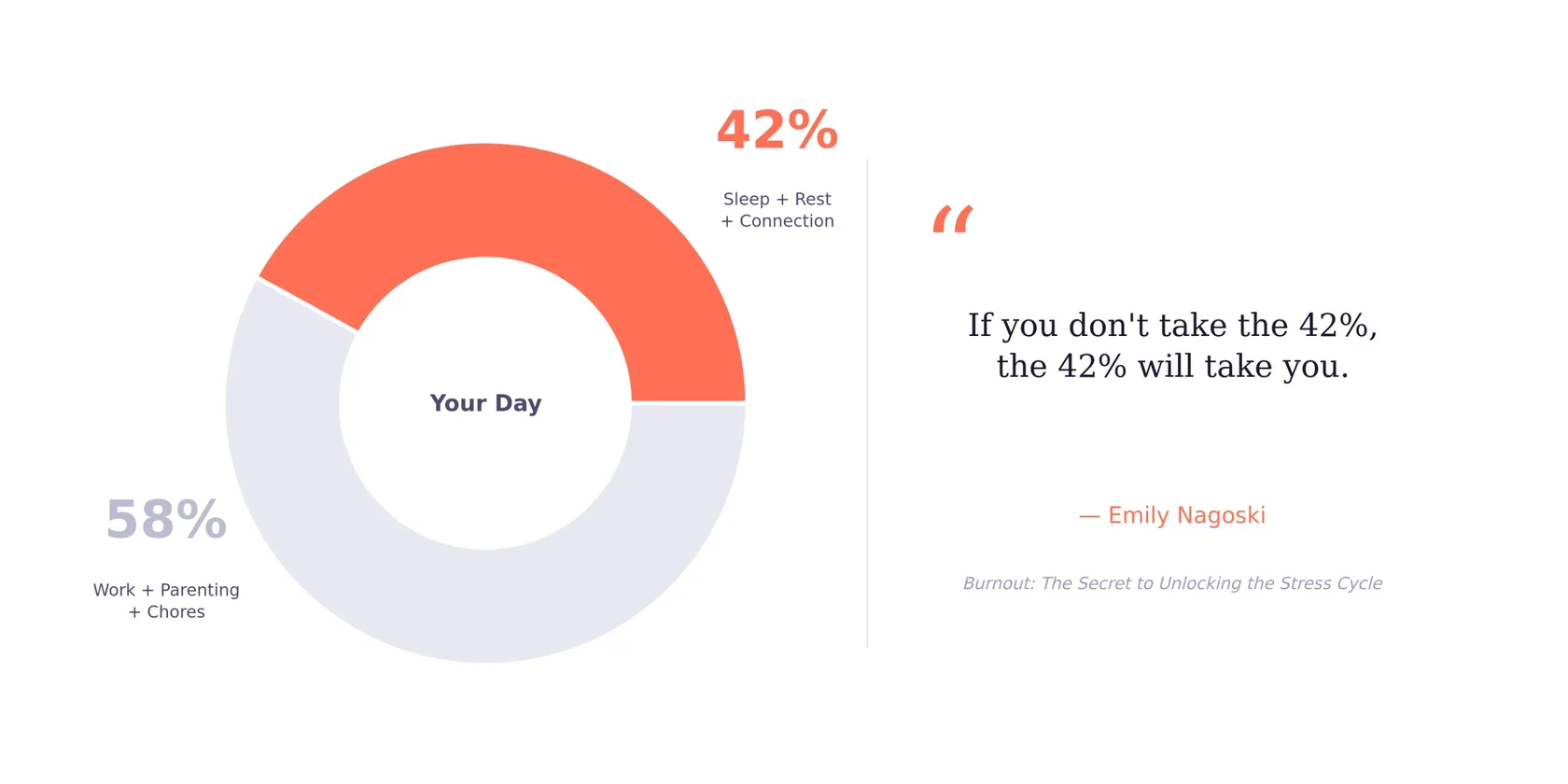
Emily Nagoski's research established a clear threshold: humans need approximately 42% of their time — roughly 10 hours per day — in genuine recovery mode. Sleep, recreation, connection. Not doom-scrolling. Not lying down while mentally working through the to-do list.
"If you don't take the 42%, the 42% will take you."
Start with 30 minutes of genuinely off-duty time. Not productive. Not useful. Just off.
Research shows measurable burnout reduction within 8 weeks from this single change.
Step 3: The STOP Method
When you feel yourself about to say something you'll regret:
- Stop. Physically stop moving.
- Take a breath. Slow. Long exhale.
- Observe. What are you feeling? No judgment.
- Proceed. Choose your next action consciously.
30 seconds. It gives your prefrontal cortex time to come back online.
It works. Use it.
Step 4: The HALT Check
Before reacting to your child, ask four questions:
Am I Hungry? Angry? Lonely? Tired?
These four states are responsible for the vast majority of parenting regrets. When your tank is empty, your child's normal behavior feels like a personal attack.
Not a cure. A 5-second pause that makes a better response possible.
Step 5: Build a Parent Pod (4-6 People)
Structured small groups of 4 to 6 parents, who explicitly agree to swap childcare, share meals, and check in weekly, show a 68% utilization rate.
Vague "reach out if you need me" networks: 23%.
The difference is not how much people care.
It is whether the agreement is specific enough to act on.
Don't wait for someone to offer. Make a concrete proposal: "I watch your kids Monday, you watch mine Tuesday." Specificity is what makes support real.
Step 6: The Self-Compassion Mantra
Place your hand on your chest. Say this:
"This is hard. I'm doing my best. I am a good parent."
Research from Kristin Neff at University of Texas shows self-compassion measurably reduces cortisol within minutes.
The care you extend to your children is care you are allowed to give yourself.
Step 7: The One-Thing Rule
On your hardest days, commit to one meaningful parenting action.
Read one story. Take one 10-minute walk. Have one real conversation without your phone.
That counts.
Small, consistent action breaks the despair cycle. Not because it solves everything. Because it proves you can still do something that matters.
Step 8: Get Structured Support
If you've used steps 1–7 for two weeks and feel no movement, it's time for professional support.
That is not weakness.
That is appropriate escalation.
The data here is worth pausing on.
Among parents who received structured professional support every two weeks, 89% remained in recovery when measured at the 12-month mark.
Among parents who went through recovery without that ongoing contact, the number dropped to 62%.
Same burnout. Same starting point. Different support structure.
The gap between those two outcomes is not willpower. It is not motivation. It is the presence or absence of external structure at the moments when internal structure collapses.
The 7-7-7 Rule: Minimum Investment, Maximum Connection
One of the most evidence-backed tools for burned-out parents is almost absurdly simple.
21 intentional minutes a day.
The 7-7-7 Rule for Children:
These 21 minutes don't need to be elaborate. They need to be real.
Disconnected presence is not the goal. Connection is.
The 7-7-7 Rule for Couples:
- A date every 7 days
- A weekend away every 7 weeks
- A real trip every 7 months
Connection is not a reward for surviving the week.
It is part of how you survive it.
How Parental Burnout Affects Your Child's Brain
This is not here to add to your guilt.
It is here to reframe self-care as an act of parenting.
Burned-out parents are significantly more likely to criticize, yell, and emotionally withdraw from their children. Often unintentionally. Longitudinal brain imaging research found that children raised by chronically stressed parents show:
- Smaller gray matter volume in the prefrontal cortex — decision-making, self-regulation
- Altered amygdala size — the brain's threat-detection center
- Weakened amygdala–prefrontal cortex connectivity — higher aggression, lower attention, greater emotional dysregulation
The children of burned-out parents don't need more enrichment classes.
They need a regulated parent.
As Professor Nim Tottenham of Columbia University states: "The best parenting advice I can give is: do everything possible to take care of your own wellbeing. When you're okay, it passes to your children in a powerful way."
When you take your 30-minute off-duty window, you are not stepping away from parenting.
You are doing the most important parenting work of the day.
How FirstGadget Helps Burned-Out Parents (Without Adding More Guilt)

One of the most painful loops in parental burnout is this:
You need a moment to breathe. Your child gets the iPad. You immediately feel terrible. That guilt compounds the burnout you were trying to recover from.
FirstGadget was built to break this loop. Not with more content. With a different architecture.
1. Psychologist-designed tasks, not passive watching.
250+ learning activities across 5 development areas. Not cartoons. Intentional structured engagement.
250+ learning activities across 5 development areas. Not cartoons. Intentional structured engagement.
2. Half the tasks happen off the screen.
Screen-to-Real: the app directs your child to do something in the real world. Then come back and log it. Your child gets genuine development. You get genuine minutes of calm.
Screen-to-Real: the app directs your child to do something in the real world. Then come back and log it. Your child gets genuine development. You get genuine minutes of calm.
3. It builds independence.
A more independent child means fewer demands on your depleted reserves. The app is working on your recovery even when you're not in the room.
A more independent child means fewer demands on your depleted reserves. The app is working on your recovery even when you're not in the room.
4. Zero ads. Zero guilt.
No algorithm designed to maximize screen time. A bounded environment — so your off-duty minutes actually feel like off-duty.
No algorithm designed to maximize screen time. A bounded environment — so your off-duty minutes actually feel like off-duty.
5. Structure you don't have to create.
Burnout impairs planning. That is documented. The app provides the structure you don't currently have the capacity to generate.
Burnout impairs planning. That is documented. The app provides the structure you don't currently have the capacity to generate.
You don't have to figure it out. You just hand your child the tablet and breathe.
When to Get Professional Help
Please reach out to a mental health professional if you experience any of the following:
☐ Burnout symptoms for more than 2 weeks with no improvement
☐ Loss of pleasure in all areas of life (not just parenting)
☐ Intrusive thoughts about harming yourself or your child
☐ Inability to care for your children's basic safety needs
☐ Substance use to cope with parenting stress
☐ Sleep so disrupted it is affecting your physical health
☐ Anxiety or panic attacks
If you're not sure whether you need help, the answer is yes.
Therapy is not for people who are broken. It is for people who are carrying more than one person should carry alone.
A Note to Dads (Because You're Not Exempt)
1 in 3 fathers is burned out.
74% say parenting duties affect their job performance. 42% meet clinical criteria for parental burnout.
And almost no one is talking to dads about it.
The symptoms are identical. The causes are identical. The recovery path is identical.
The only difference is that men are less likely to be asked — and much less likely to ask.
Not because dads don't struggle. Because struggling was never supposed to be visible.
That is not a personal choice. That is a cultural design problem.
If you're a dad reading this: the exhaustion is real. The disconnection is real. The sense of running on empty while still showing up — that's real.
You don't have to call it burnout. But please don't call it "just how it is."
Your First Step Starts Right Now
Recovery from parental burnout doesn't start with a perfect plan.
It starts with one honest moment.
You've read this article. Something in you recognized something here. That recognition is the first step — and it is not a small one.
Try this today.
Set a 30-minute window on your calendar. Label it OFF DUTY. Close the door. Hand off to your partner or let the app handle it. Do absolutely nothing that qualifies as productive.
Just exist. Just breathe. Just be a person for 30 minutes.
That is not the whole answer.
But it is where the whole answer begins.

Your Parenting Co-Pilot
Less talk, more action. Turn daily routines into fun missions kids actually want to finish.
Available on iOS & Android