

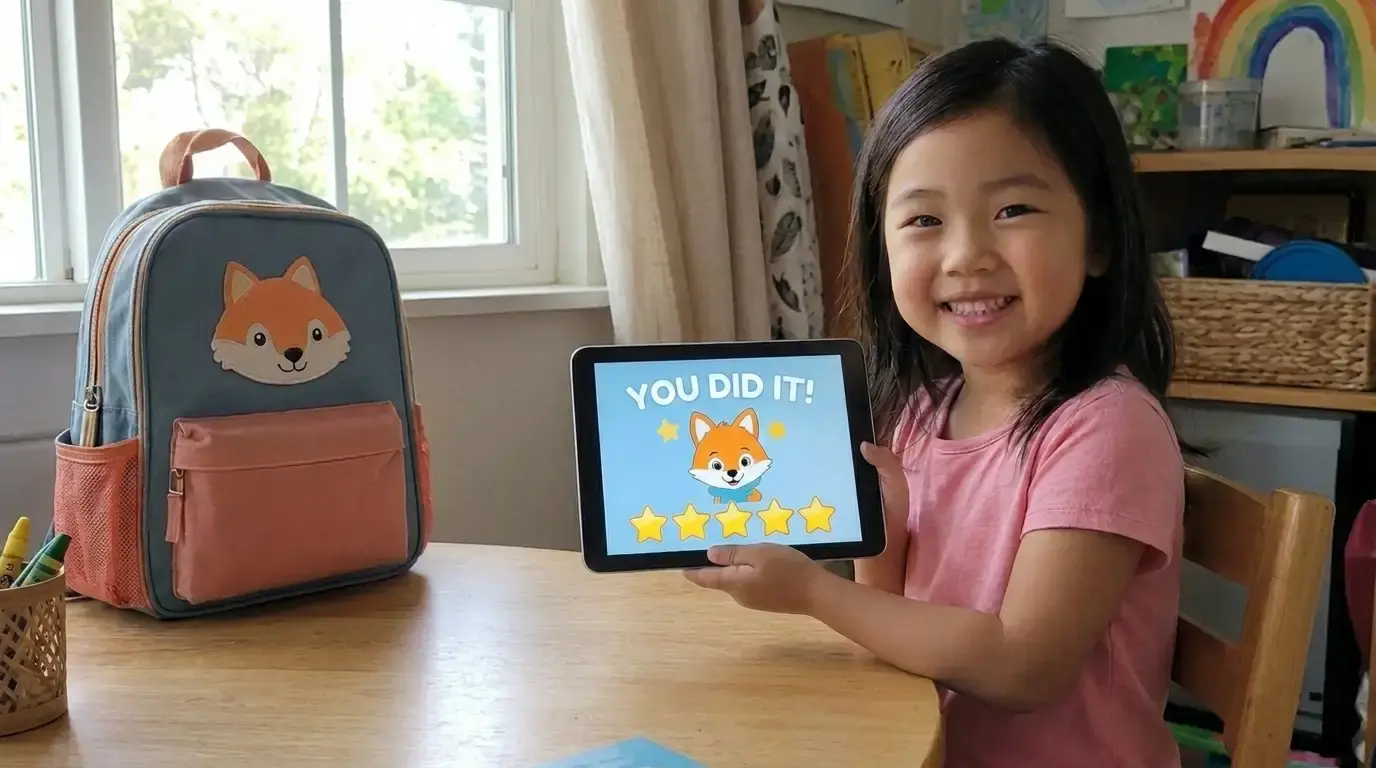
The 15 Best Learning Apps for 4-Year-Olds (2026): Educational Games That Actually Prepare Kids for Kindergarten
Quick Answer (Featured Snippet)
The best learning apps for 4 year olds in 2026 are the ones built around what a child must master in the final year before kindergarten: multi-step listening, letter sounds, and emotional self-regulation. Our #1 pick for kindergarten prep is First Gadget (18/18) — it turns real-world morning and evening routines into 5-minute quests with Kevin the Fox. Proven academic companions include Khan Academy Kids (best free all-around), HOMER (best phonics), and Duolingo ABC (best letter writing).
In this guide:
Age 4: The Milestone Shift Before Kindergarten
Four is the year everything shifts. Your child stops being a "toddler" and starts being a student-in-training: holding a crayon with intent, noticing letter sounds, and counting past ten. It is also the year tablet use expands rapidly — according to the Common Sense Census (2025), 58% of 4-year-olds now have their own tablet, and gaming time among preschoolers has surged by +65% over the last four years.
Meanwhile, data from the National Survey of Children's Health (NSCH) reveals a sobering reality: only 63.6% of 3-to-5-year-olds are "on track" in 4–5 core school-readiness domains.
If your child is still working on first-tablet basics and simple 2-step sensory games, start with our guide to the best apps for 3-year-olds. For our full cross-age ranking, explore the 25 best educational games for kids.
The tablet is already in your house. The real question is whether it is preparing your child for the classroom or simply capturing their attention. That is the promise of this guide: 15 milestone-matched learning apps for 4-year-olds, evaluated by a child psychologist for real kindergarten readiness, overstimulation risk, and transparent 2026 pricing.
Why Age 4 Is the Critical Readiness Window
Kindergarten is roughly 12 months away. The foundational skills your child builds this year are the exact benchmarks teachers evaluate on day one.
Per the CDC's developmental milestones for 4-year-olds, a typical four-year-old can name a few colors, tell what comes next in a well-known story, draw a person with 3 or more body parts, and follow multi-step directions while engaging in back-and-forth conversations. That is not an arbitrary checklist; it represents the neurological scaffold of pre-literacy, pre-numeracy, and executive function.
Age 4 is also covered by the AAP Bright Futures clinical framework: no more than 1 hour per day of high-quality programming, integrated into an intentional family media plan. Why does this boundary matter? A 4-year-old’s brain is an active pattern-seeker. The apps below teach loops that finish in the physical world — drawing on real paper, sorting physical objects, or packing a bag — rather than loops engineered to keep small fingers tapping endlessly.
What Should a 4-Year-Old Know Before Kindergarten?
Teachers do not expect 4-year-olds to read chapter books or solve arithmetic. They look for the foundations: letter sounds, counting to 20, story sequencing, following multi-step directions, and emotional self-regulation.
Here is the checklist, synthesized directly from the CDC and NSCH benchmarks:
- Names a few colors (CDC, age 4)
- Tells what comes next in a familiar story (CDC, age 4) — story comprehension
- Draws a person with 3+ body parts (CDC, age 4) — fine motor grip
- Follows 2- to 3-step directions — the executive function skill pre-K teachers grade hardest
- Recognizes letter sounds (phonemic awareness) — the phonics window opens naturally at ~4
- Counts to 20 and compares quantities (more vs. less)
- Regulates emotional transitions — 10.6% of 3–5-year-olds need developmental support here, the most common readiness gap
Milestone → App: What Actually Builds School Readiness
Keep this table in mind before hitting download. If an app does not train at least one of these pillars, it is screen entertainment with an "educational" sticker.
The Best Learning Apps for 4-Year-Olds in 2026
We evaluated 15 apps from the kindergarten-prep angle: does this app train a skill a 4-year-old actually needs over the next 12 months?
How We Tested & Ranked
Each app was scored on three core criteria (scored 1–6; 6 = excellent, inverted scale — maximum score 18/18), adapted from pediatric media frameworks by the American Academy of Pediatricsand Common Sense Media:
- Milestone mapping — does it train a verified CDC/NSCH benchmark, or generic arcade taps?
- Offline skill transfer — does the child perform the task in real life, or only on screen?
- Overstimulation risk — flashing rewards, autoplay ads, and manipulative dopamine loops penalize the score.
A note on bias: First Gadget is the app I co-founded, and it scored 18/18 on these metrics. It is listed first for that reason — and every competitor's honest trade-offs are detailed below.
🏆 Hero Matrix: The 5 Apps That Justify Screen Time
AppCore StrengthOverstimulation RiskOffline Skill TransferPrice & AdsScore
First Gadget
Screen-to-Real quests — kindergarten routines as missions
Low (0 ads, finite sessions, no push loops)
★★★★★ highest: quest ends → child completes real task
Free + $4.99/wk, zero ads
18/18
Khan Academy Kids
5,000+ activities aligned to Head Start & Common Core
Low (calm design, no timers)
★★★★ math & letter practice with parents
100% Free, no ads
16/18
HOMER Learn & Grow
Personalized phonics & early reading path
Moderate (reward animations)
★★★★ story retelling transfers to physical books
$12.99/mo or $59.99/yr
15/18
Duolingo ABC
Letter writing & handwriting tracing
Low (short lessons, no ads)
★★★★ pencil grasp & paper writing readiness
100% Free, no ads
16/18
ABCmouse
13,000+ activities on a guided preschool path
Moderate (coin economy)
★★★ multi-step navigation practice
$12.99/mo, no 3rd-party ads
14/18
#1 — First Gadget ★ Best Overall for Kindergarten Prep (18/18)
Age 4 is the sweet spot for First Gadget because the gameplay loop is kindergarten rehearsal. Every quest is a structured two- or three-step routine — brush teeth, tidy toys, pack the backpack — the exact multi-step listening skill pre-K teachers emphasize most.
Kevin the Fox guides the short quest on screen. The child completes the mission in the physical world, and the app celebrates real-world effort rather than endless screen tapping.
It scored a maximum 6 on Overstimulation Risk (zero ads, finite 5-minute sessions, no loot boxes) and the highest Offline Skill Transfer of the pool. The architecture includes 50+ finite mini-games, audio stories that never auto-advance, and a Parent Portal showing what real-world routines your child completed.
The honest trade-off: It is designed for habit building and executive function, not academic drills. Pair it with one dedicated phonics app for full kindergarten readiness.
#2 — Khan Academy Kids ★ Best Free All-Around
A genuinely free, ad-free library of 5,000+ activities covering the alphabet, counting, and social-emotional learning, aligned with Head Start and Common Core standards. It is character-led, calm, and the closest thing to a free preschool curriculum on a tablet.
- Price: 100% Free (no subscriptions, no ads).
- The Trade-off: The interface is expansive. A 4-year-old can easily jump between activities without mastering a single skill unless a parent actively guides the session.
#3 — HOMER Learn & Grow ★ Best for Phonics
HOMER creates a customized early reading path based on your child's specific interests (like space, animals, or construction). Age 4 is the golden age for phonics, and HOMER excels at connecting letter sounds to early word building.
- Price: $12.99/month or $59.99/year.
- The Trade-off: Requires consistent weekly usage to justify the subscription cost; literacy-only focus means you need separate math tools.
#4 — Duolingo ABC ★ Best Free Letter Writing
The cleanest free letter-tracing tool available: children practice letter formation, phonics sounds, and early sight words in bite-sized, gamified lessons.
- Price: 100% Free (no ads, no paywall).
- The Trade-off: It is a focused drill tool rather than a comprehensive curriculum. Best used for a daily 10-minute "letter of the day" session.
#5 — ABCmouse ★ Best Full Curriculum
A massive early learning ecosystem featuring 13,000+ activities across reading, math, science, and art, organized into a guided step-by-step learning path.
- Price: $12.99/month.
- The Trade-off: The ticket and virtual reward economy can encourage children to rush through exercises for prizes. Parents should set boundaries to keep attention on learning.
Best Apps by Skill (Tested & Verified)
Letters & Phonics
Montessori Preschool (Edoki) ★ Best Self-Directed Phonics
- Price: $9.99/month or $59.99/year.
- CDC Milestone: Letter sounds ("I spy" sound games) and early writing.
- The Win: Authentic Montessori multi-sensory method; works completely offline.
- The Trade-off: Requires high self-direction. Works best when paired with physical Montessori sandpaper letters at home.
Endless Numbers ★ Best Number Sense Exploration
- Price: $14.99 full bundle (or $6.99 starter pack).
- CDC Milestone: Number sequences, counting to 20, and quantity awareness.
- The Win: Lovable monsters turn abstract numbers into physical quantities that interact on screen.
- The Trade-off: One-time purchase price is on the higher side; narrow single-subject focus.
Elmo Loves 123s ★ Best Early Number Recognition
- Price: $4.99 one-time purchase (Sesame Workshop).
- CDC Milestone: Tracing numbers 1–20 and basic counting.
- The Win: Familiar, comforting Sesame Street characters teach number tracing and coloring pages.
- The Trade-off: Limited replay value once your 4-year-old masters basic number tracing.
Math Readiness
SplashLearn ★ Best Adaptive Math Progression
- Price: Free starter tier; full curriculum $11.99/month or $59.99/year.
- CDC Milestone: Counting to 20, comparison (more/less), and basic geometry.
- The Win: 4,000+ games with an adaptive algorithm that recalibrates difficulty based on real-time answers.
- The Trade-off: The game-like reward mechanics can lead to excessive screen time unless parent limits are enforced.
Moose Math ★ Best Free Early Numeracy
- Price: 100% Free (Duck Duck Moose, zero ads).
- CDC Milestone: Counting, sorting, and introductory addition/subtraction.
- The Win: Five cheerful mini-games set inside a juice stand; perfectly tuned to Pre-K math standards.
- The Trade-off: Relatively short lifespan; most 4-year-olds complete the full progression within 3–4 months.
Full Curriculum & Social Play
Kids Academy (Talented & Gifted) ★ Best Printable Worksheets
- Price: $19.99/month or $97.99/year.
- CDC Milestone: Fine motor pencil grip ("draws a person with 3+ parts") and logic.
- The Win: 5,000+ on-screen activities backed by thousands of printable worksheets for real table practice.
- The Trade-off: Highest monthly subscription cost in this review; requires active parent involvement to print and oversee worksheets.
Kiddopia ★ Best Social Role-Play
- Price: $12.99/month or $79.99/year.
- CDC Milestone: Social-emotional turn-taking and creative problem solving.
- The Win: Over 1,000 role-playing scenarios (cooking, pet care, fixing cars) that operate 100% offline.
- The Trade-off: Broad rather than deep; best enjoyed when parents or siblings co-play to extend social scripts.
Budge World ★ Best Character-Driven Motivation
- Price: $9.99/month or $71.99/year.
- CDC Milestone: Imaginative play and travel distraction.
- The Win: Officially licensed worlds (PAW Patrol, Barbie, Thomas & Friends) that work offline on road trips.
- The Trade-off: Educational depth varies widely across franchises; leans more toward entertainment than core academic prep.
Character Learning & International Options
PBS KIDS Games ★ Best Free Science & Curiosity
- Price: 100% Free (zero ads).
- CDC Milestone: Social-emotional scripts, curiosity, and early problem solving.
- The Win: 280+ mini-games based on trusted shows like Wild Kratts and Daniel Tiger with zero commercial pressure.
- The Trade-off: Episodic structure lacks a linear learning path; excellent supplement, but not a standalone curriculum.
CBeebies Learn (UK) ★ Best British Curriculum Alternative
- Price: 100% Free (BBC).
- CDC Milestone: Early Years Foundation Stage (EYFS) literacy and numeracy.
- The Win: Gentle, non-commercial early learning games featuring Numberblocks and Alphablocks.
- The Trade-off: Aligned with the UK educational framework, so certain phonics progressions differ slightly from US kindergarten standards.
Screen Time at 4: The 1-Hour AAP Framework
The American Academy of Pediatrics (AAP) Bright Futuresguidelines limit 4-year-olds to no more than 1 hour per day of high-quality media.
Yet data from the Canadian Paediatric Society indicates that only ~15% of preschoolers actually stay under this threshold.
To make the daily 60 minutes work without meltdowns, apply three practical rules:
- Split the hour into two 20–30 minute blocks: A 4-year-old’s executive function fatigues quickly. Two focused sessions (morning routine + afternoon phonics) yield far better skill retention than one long screen marathon.
- End every session with a physical transition: Use apps with explicit stopping moments (like First Gadget quests). A transition prompt ("Quest finished — let's pack your real backpack!") prevents turn-off resistance.
- Protect bedtime by 60 minutes: Keep tablets out of the bedroom. Melatonin suppression from evening blue light is the primary driver of late-night bedtime battles.
Comparison Table: Free vs. Paid vs. Offline at Age 4
ModelTop PicksTypical PriceBest ForWhat to Watch For
100% Free
Khan Academy Kids, Duolingo ABC, PBS KIDS Games, Moose Math
$0, zero ads
Budget-conscious families
Less structured progress tracking; requires parent guidance
Paid Subscription
First Gadget ($4.99/wk), ABCmouse ($12.99/mo), HOMER ($12.99/mo), Kids Academy ($19.99/mo)
$9.99–$19.99/mo
Complete curriculum & guided paths
Cancel unused trials; monitor in-app reward economies
One-Time Purchase
Endless Numbers ($14.99), Elmo Loves 123s ($4.99)
$4.99–$14.99 one-time
Families avoiding recurring fees
Narrower scope; apps focus on a single subject area
Offline-Ready
First Gadget, Kiddopia, Montessori Preschool, Budge World
Included in base app
Flights, travel, and screen-free homes
Sync content updates occasionally over Wi-Fi
The smart budget stack: One free phonics app (Duolingo ABC) + one free math app (Moose Math or Khan Academy Kids) covers 90% of academic prep for $0. Add First Gadget ($4.99/wk) to anchor daily routines and transition habits.
What Parents Say
"We started the kindergarten-prep quests in September. The 'tidy up your toys and pack your bag' quest was the first time she completed a three-step instruction without having a meltdown." — Sarah M., mom of a 4-year-old, Austin, TX
"Our pediatrician told us to cap tablet time at an hour and make it count before pre-K. Kevin the Fox gives her that structured finish line so the tablet goes away without a fight." — Jessica T., mom of a 4-year-old, Denver, CO
How First Gadget Prepares 4-Year-Olds for Kindergarten
As a child psychologist, I look at age 4 as the window of readiness for internal rules — the developmental phase where children learn to follow multi-step sequences independently and feel genuine pride in their autonomy.
First Gadget is built around that exact window:
- Kindergarten routines as quests: Brushing teeth, putting on shoes, packing the backpack — every mission rehearses the multi-step directions preschool teachers demand, with Kevin the Fox as an encouraging coach rather than a nagging parent.
- Screen-to-Real™ by design: The quest finishes on screen, and the child carries the momentum into the physical room. The tablet is the launchpad; the real world is the reward.
- Calm, finite architecture: 50+ deliberately short mini-games with zero ads, zero infinite dopamine loops, and audio tales that never auto-advance.
- Parent Portal: See the physical habits your child actually completed instead of passive screen time metrics.
- Transparent pricing: Free starter tier + $4.99/week premium.
FAQ: Learning Apps for 4-Year-Olds
What apps do 4 year olds play?
Four-year-olds play apps matched to their emerging pre-K milestones: letter sounds (Duolingo ABC, HOMER), number games (Moose Math, Endless Numbers), comprehensive curricula (Khan Academy Kids, ABCmouse), and routine-building quest apps like First Gadget.
How much screen time is OK for a 4-year-old?
The AAP recommends no more than 1 hour per day of high-quality media. We recommend splitting this into two 20–30 minute sessions within a predictable family media schedule.
When should I start phonics with my 4-year-old?
Age 4 is the ideal window for phonemic awareness (letter sounds). Start with 10-minute game-like sessions using Duolingo ABC or HOMER. If your child resists, pause and return in a few months — phonics should always feel playful at this age.
Are tablets good for 4 year olds?
Yes, when used with clear structure. Over 58% of 4-year-olds own a tablet. The key is selecting ad-free apps that end with an offline handoff into physical play or daily routines.
What is the best free learning app for a 4-year-old?
Khan Academy Kids is the premier free all-around app with 5,000+ activities. Duolingo ABC is the top free pick for handwriting and letter tracing, while Moose Math is ideal for early numeracy.
What should a 4-year-old know before kindergarten?
Per CDC benchmarks: naming colors, story sequencing, drawing a person with 3+ parts, following multi-step directions, counting to 20, and managing emotional transitions without severe meltdowns.
What is the best learning app for kindergarten prep?
First Gadget is #1 for routine and executive function readiness (18/18). Pair it with Duolingo ABC for letter tracing and Moose Math or Khan Academy Kids for academic numeracy.
What apps have no ads for 4 year olds?
First Gadget, Khan Academy Kids, Duolingo ABC, PBS KIDS Games, and Moose Math are 100% ad-free. Paid apps like ABCmouse and HOMER are ad-free by subscription design.
How do I stop screen-time tantrums at 4?
Predictable endings beat willpower. Choose apps with clear completion moments (like Screen-to-Real quests), use visual countdown timers, and never pull the device away mid-game.
The Bottom Line: Prep for Kindergarten Without the Screen Trap
Most educational games for 4-year-olds are entertainment wrapped in school-themed graphics. The apps that truly matter this year build tangible milestones: letter sounds, counting to 20, two-step directions, and calm transitions.
- Best overall: First Gadget (18/18) — kindergarten routines as quests, Screen-to-Real design, zero ads.
- Best free staple: Khan Academy Kids (letters, numbers, SEL).
- Best phonics start: Duolingo ABC (free) or HOMER ($12.99/mo).
- Best math start: Moose Math (free) or Endless Numbers ($14.99).
You have 12 months before the big yellow bus arrives. Make screen time a launchpad for real-world growth: one hour, planned, ending in the real world.
Next in the age series: Best Educational Games for 5-Year-Olds (Kindergarten Edition)
About the Author
Ksenia Maenz is a child psychologist and co-founder of First Gadget. She has spent six years researching early child development, executive function, and screen-time regulation across the US and Europe. Her app-evaluation methodology aligns with AAP screen time guidelines and CDC developmental milestones. She co-founded First Gadget to help parents convert passive screen time into lifelong real-world habits.